Nothing officially changed.
Same headcount.
Same roles.
Same salaries.
Same deadlines.
Yet somehow, things started breaking.
Work that used to get done quietly stopped happening.
Small delays stacked up.
Handovers became brittle.
Teams that "always managed" suddenly couldn't.
Managers blamed attitude.
Executives blamed burnout.
Everyone agreed something had gone wrong with people.
That explanation is comforting.
It's also wrong.
The invisible thing your system was running on
Most organizations don't run on job descriptions.
They run on favors.
Someone staying late without being asked.
Someone fixing a mess they didn't create.
Someone absorbing ambiguity so others don't feel it.
Someone taking responsibility without authority.
None of this appears in a contract.
None of it shows up in dashboards.
Yet it's everywhere.
Call it the extra mile if you want.
Call it commitment.
Call it ownership.
What matters is this:
your system depended on it without ever acknowledging it.
Why nothing broke at first
Here's the trick.
You can keep extracting unpaid effort for a long time without consequences.
People comply because:
- they care
- they're proud
- they don't want to be "that person"
- they don't have better options
From the outside, everything looks stable.
From the inside, buffers are being eaten.
And because nothing fails immediately, leaders conclude:
"This is sustainable."
It isn't.
It's just unpriced.
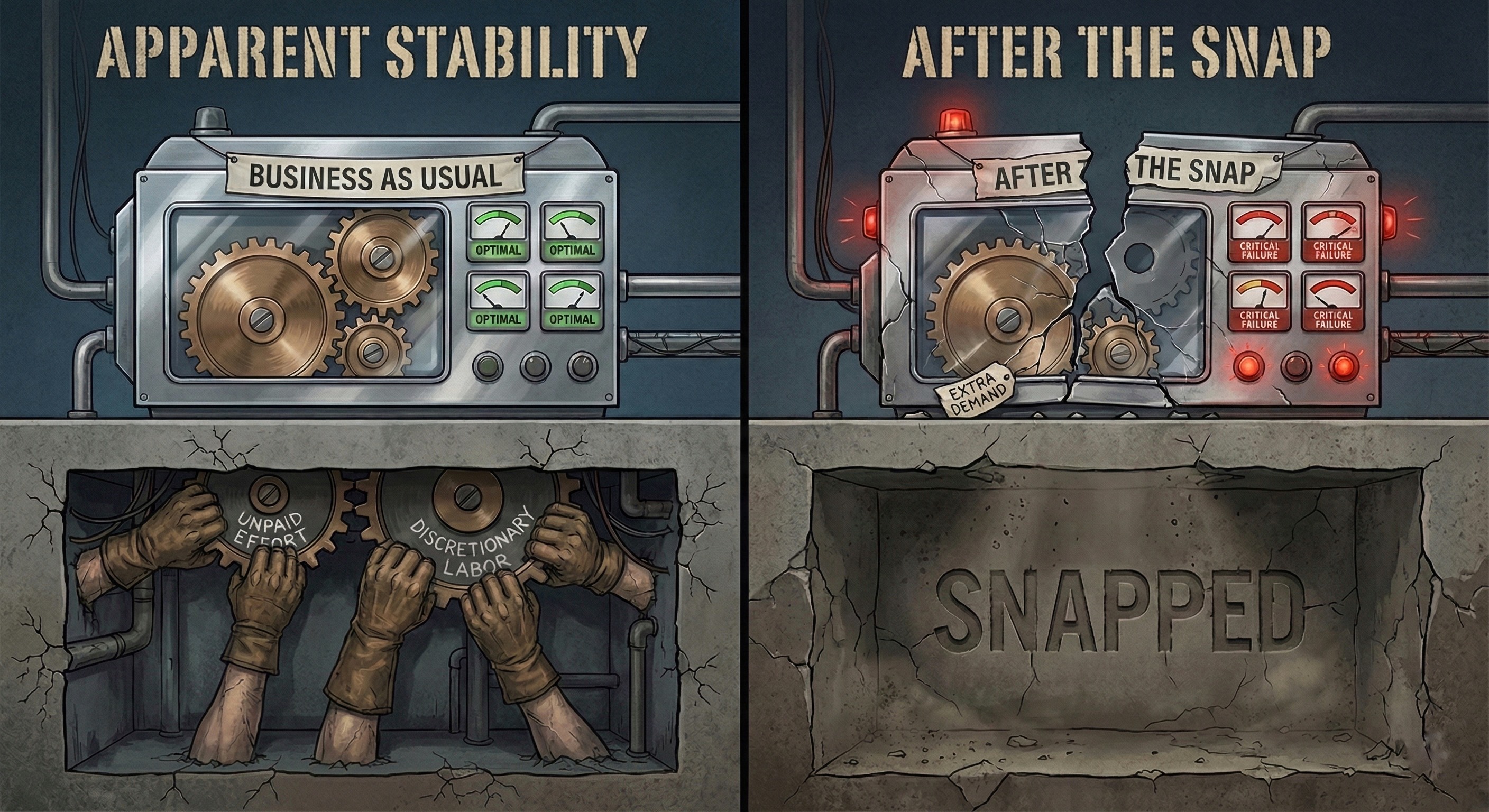
The moment it snaps
The break rarely comes from the thing you expect.
It's not the pay cut.
It's not even the workload.
It's the moment when one more demand lands on a system that has no slack left.
A new regulation.
A tighter review.
An extra reporting requirement.
A "temporary" staffing optimization.
People don't protest.
They just stop compensating.
They stop fixing what isn't their job.
They stop absorbing what leadership refuses to own.
They stop carrying the system quietly on their backs.
From management's point of view, performance collapses overnight.
From the workforce's point of view, they simply stopped donating labor.
This is what "nothing broke" actually looked like.
The lie that keeps repeating
Every time this happens, the same story is told:
"People don't care anymore."
"Work ethic has changed."
"Everyone wants balance now."
That story is useful.
It places the problem safely inside individuals.
The real story is harder to admit:
The system was designed assuming people would keep giving more than they were paid for.
Once that assumption failed, there was nothing underneath.
Where you'll see this next
This pattern isn't rare.
You'll see it anywhere:
- responsibility grows while authority shrinks
- accountability remains while security disappears
- "temporary" strain becomes permanent
- informal effort replaces real capacity
The collapse always looks sudden.
The cause never is.
The uncomfortable question
If people did exactly what their role required tomorrow; no more, no less
Which parts of your organization would stop working?
And how long have you known the answer without saying it out loud?
- rohanchatters